

Ever noticed how you’re spending less time clicking through a list of links and more time just… getting an answer? That’s because the search game just changed. Let’s talk about what’s coming next.
Remember the old days? You’d type something into Google, scan the “ten blue links,” click a few, hit the back button, and eventually find what you needed. It worked. But then came the AI era.
Now, we have ChatGPT, Perplexity, Gemini, and Google’s AI Overviews. Instead of giving us a map to the answer, they are the answer. If your business relies on people finding you online, you’ve probably heard a new term buzzing around: GEO.
Wait, what is GEO?
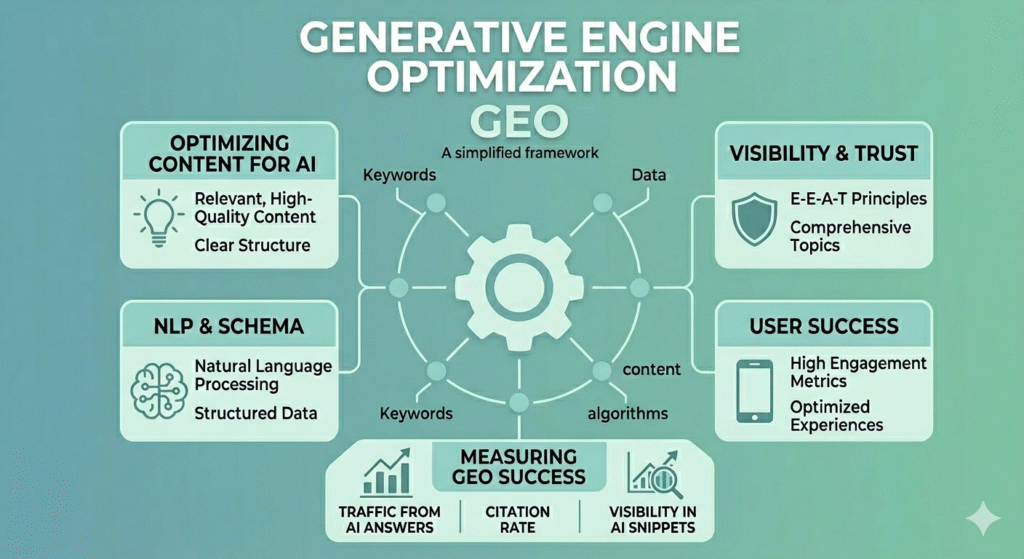
Generative Engine Optimization (GEO) is basically the “new school” of SEO. While traditional SEO focuses on ranking your page at the top of a search result, GEO focuses on getting your content cited, summarized, and recommended by AI engines.
The GEO Mantra:
Be Retrievable → Be Groundable → Be Credited.
In plain English? It’s not about being #1 on page one anymore. It’s about being the source the AI trusts enough to put in its response.
SEO vs. GEO: Are they fighting?
Short answer: No. They’re more like siblings. SEO is the older brother who knows how to handle the infrastructure and keywords. GEO is the younger sister who knows how to talk to the AI.
“SEO is about visibility in organic results. GEO is about visibility in synthesized outputs.”
You still need SEO because AI engines use those same “blue link” indexes to find information. But if you only do SEO, you might be the top result that the AI reads, but doesn’t actually mention in the summary. That’s where GEO kicks in.
The Secret Sauce: How to actually "do" GEO
So, how do you make an AI love your content? It’s not about keyword stuffing (that’s so 2010). It’s about credibility and structure.
- Double Down on E-E-A-T: Experience, Expertise, Authoritativeness, and Trustworthiness. AI engines are terrified of “hallucinating.” They look for first-hand experience. Don’t just say “The best way to hike the Alps is…” say “During my three-week trek through the Alps last July, I found that…”
- Feed the AI Data: AI loves specifics. Instead of saying “many people use our tool,” say “74% of 500 surveyed CTOs reported a 20% increase in efficiency.” Statistics make your content “groundable.”
- Speak “Robot” with Schema: Use structured data (Schema.org). When you useOrganization, Article,orFAQ schema, you’re essentially giving the AI a cheat sheet, telling it exactly what your content is and how it connects to other topics.
- The Power of the Crowd: Reviews and third-party mentions are huge. If Reddit, Quora, and industry blogs are talking about you, the AI views you as a “trusted entity.”
Looking Ahead: The "Agentic" Web
We’re moving toward a world of “Agentic Search,” where AI doesn’t just answer questions but actually performs tasks for us. In this future, your brand won’t just be a website; it’ll be an entity that AI agents can rely on.
The goal isn’t to “trick” the algorithm anymore, it’s to be the most helpful, most credible source in the room. When you focus on providing genuine value and clear structure, the AI will do the promoting for you.